Thursday, March 5, 2009

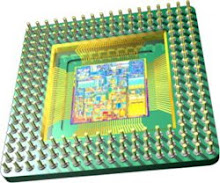
World’s Fastest Microprocessors


IBM today introduced a new supercomputer powered by one of the world’s fastest microprocessors and cooled by an innovative water system . The new Power 575 supercomputer, equipped with IBM’s latest POWER6 microprocessor, uses water-chilled copper plates located above each microprocessor to remove heat from the electronics. Requiring 80 percent fewer air conditioning units, the water-cooled Power 575 can reduce typical energy consumption used to cool the data center by 40 percent. IBM scientists estimate that water can be up to 4,000-times more effective in cooling computer systems than air.


With 448 processor cores per rack, the new Power 575 offers more than five times the performance of its predecessor. A single rack features 14 2U nodes, each with 32, 4.7-Ghz cores of POWER6, and 3.5 TB of memory. At 600 GFlops per node, the Power 575 is three times more energy-efficient in GFlops per kilowatt than the POWER5 generation of air-cooled processors .

2003: Intel® Pentium® M Processor

The Intel® Pentium® M processor, the Intel® 855 chipset family, and the Intel® PRO/Wireless 2100 network connection are the three components of Intel® Centrino™ mobile technology. Intel Centrino mobile technology is designed specifically for portable computing, with built-in wireless LAN capability and breakthrough mobile performance. It enables extended battery life and thinner, lighter mobile computers

2002: Intel® Itanium™ 2 Processor

The Itanium™ 2 processor is the second member of the Itanium processor family, a line of enterprise-class processors. The family brings outstanding performance and the volume economics of the Intel® Architecture to the most data-intensive, business-critical and technical computing applications. It provides leading performance for databases, computer-aided engineering, secure online transactions, and more.

2001: Intel® Itanium™ Processor

The Itanium™ processor is the first in a family of 64-bit products from Intel. Designed for high-end, enterprise-class servers and workstations, the processor was built from the ground up with an entirely new architecture based on Intel's Explicitly Parallel Instruction Computing (EPIC) design technology. The processor delivers world-class performance for the most demanding enterprise and high-performance computing applications, including e-Commerce security transactions, large databases, mechanical computer-aided engineering, and sophisticated scientific and engineering computing

2001: Intel® Xeon™ Processor

The Intel® Xeon™ processor is targeted for high-performance and mid-range, dual-processor workstations, dual and multi-processor server configurations coming in the future. The platform offers customers a choice of operating systems and applications, along with high performance at affordable prices. Intel Xeon processor-based workstations are expected to achieve performance increases between 30 and 90 percent over systems featuring Intel® Pentium® III Xeon™ processors depending on applications and configurations. The processor is based on the Intel NetBurst™ architecture, which is designed to deliver the processing power needed for video and audio applications, advanced Internet technologies, and complex 3-D graphics.

2000: Intel® Pentium® 4 Processor


Users of Intel® Pentium® 4 processor-based PCs can create professional-quality movies; deliver TV-like video via the Internet; communicate with real-time video and voice; render 3D graphics in real time; quickly encode music for MP3 players; and simultaneously run several multimedia applications while connected to the Internet. The processor debuted with 42 million transistors and circuit lines of 0.18 microns. Intel's first microprocessor, the 4004, ran at 108 kilohertz (108,000 hertz), compared to the Intel® Pentium® 4 processor's initial speed of 1.5 gigahertz (1.5 billion hertz). If automobile speed had increased similarly over the same period, you could now drive from San Francisco to New York in about 13 seconds.

1999: Intel® Pentium® III Xeon™ Processor

The Intel® Pentium III Xeon processor extends Intel's offerings to the workstation and server market segments, providing additional performance for e-Commerce applications and advanced business computing. The processors incorporate the Intel® Pentium III processor's 70 SIMD instructions, which enhance multimedia and streaming video applications. The Intel® Pentium III Xeon processor's advance cache technology speeds information from the system bus to the processor, significantly boosting performance. It is designed for systems with multiprocessor configurations.

1999: Intel® Pentium® III Processor


The Intel® Pentium® III processor features 70 new instructions--Internet Streaming SIMD extensions-- that dramatically enhance the performance of advanced imaging, 3-D, streaming audio, video and speech recognition applications. It was designed to significantly enhance Internet experiences, allowing users to do such things as browse through realistic online museums and stores and download high-quality video. The processor incorporates 9.5 million transistors, and was introduced using 0.25-micron technology.

1999: Intel® Celeron® Processor


Continuing Intel's strategy of developing processors for specific market segments, the Intel® Celeron® processor is designed for the value PC market segment. It provides consumers great performance at an exceptional price, and it delivers excellent performance for uses such as gaming and educational software.

1998: Intel® Pentium II Xeon Processor


The Intel® Pentium II Xeon processors are designed to meet the performance requirements of mid-range and higher servers and workstations. Consistent with Intel's strategy to deliver unique processor products targeted for specific markets segments, the Intel® Pentium II Xeon processors feature technical innovations specifically designed for workstations and servers that utilize demanding business applications such as Internet services, corporate data warehousing, digital content creation, and electronic and mechanical design automation. Systems based on the processor can be configured to scale to four or eight processors and beyond.

1997: Intel® Pentium® II Processor


The 7.5 million-transistor Intel® Pentium II processor incorporates Intel® MMX™ technology, which is designed specifically to process video, audio and graphics data efficiently. It was introduced in innovative Single Edge Contact (S.E.C) Cartridge that also incorporated a high-speed cache memory chip. With this chip, PC users can capture, edit and share digital photos with friends and family via the Internet; edit and add text, music or between-scene transitions to home movies; and, with a video phone, send video over standard phone lines and the Internet.

1995: Intel® Pentium® Pro Processor


Released in the fall of 1995 the Intel® Pentium® Pro processor is designed to fuel 32-bit server and workstation applications, enabling fast computer-aided design, mechanical engineering and scientific computation. Each Intel® Pentium Pro processor is packaged together with a second speed-enhancing cache memory chip. The powerful Pentium® Pro processor boasts 5.5 million transistors

1989: Intel486™ DX CPU Microprocessor


The Intel486™ processor generation really meant you go from a command-level computer into point-and-click computing. "I could have a color computer for the first time and do desktop publishing at a significant speed," recalls technology historian David K. Allison of the Smithsonian's National Museum of American History. The Intel486™ processor was the first to offer a built-in math coprocessor, which speeds up computing because it offloads complex math functions from the central proces

1985: Intel386™ Microprocessor


The Intel386 microprocessor featured 275,000 transistors--more than 100times as many as the original 4004. It was a 32-bit chip and was "multi tasking," meaning it could run multiple programs at the same time.

1982: 286 Microprocessor


The Intel 286, originally known as the 80286, was the first Intel processor that could run all the software written for its predecessor. This software compatibility remains a hallmark of Intel's family of microprocessors. Within 6 years of its release, an estimated 15 million 286-based personal computers were installed around the world

1978: 8086-8088 Microprocessor


A pivotal sale to IBM's new personal computer division made the 8088 the brains of IBM's new hit product--the IBM PC. The 8088's success propelled Intel into the ranks of the Fortune 500, and Fortune magazine named the company one of the "Business Triumphs of the Seventies."

1974: 8080 Microprocessor


The 8080 became the brains of the first personal computer--the Altair, allegedly named for a destination of the Starship Enterprise from the Star Trek television show. Computer hobbyists could purchase a kit for the Altair for $395. Within months, it sold tens of thousands, creating the first PC back orders in history.

1972: 8008 Microprocessor


The 8008 was twice as powerful as the 4004. A 1974 article in Radio Electronics referred to a device called the Mark-8 which used the 8008. The Mark-8 is known as one of the first computers for the home --one that by today's standards was difficult to build, maintain and operate.

1971: 4004 Microprocessor


The 4004 was Intel's first microprocessor. This breakthrough invention powered the Busicom calculator and paved the way for embedding intelligence in inanimate objects as well as the personal computer.

486DX2 Microprocessor


The Pentium microprocessor is released in the year 1993 . The Pentium was the fifth generation of the ‘x86’ line of microprocessors from Intel, the basis for the IBM PC and its clones. The Pentium introduced several advances that made programs run faster such as the ability to execute several instructions at the same time and support for graphics and music.